Daniel Ellsberg’s Interviews After His Cancer Diagnosis

The Ellsberg family is thankful to Julia Pacetti of Verdant Communications for coordinating Daniel’s media relations for over a decade.

Ellsberg Interview & Podcast in the New York Times

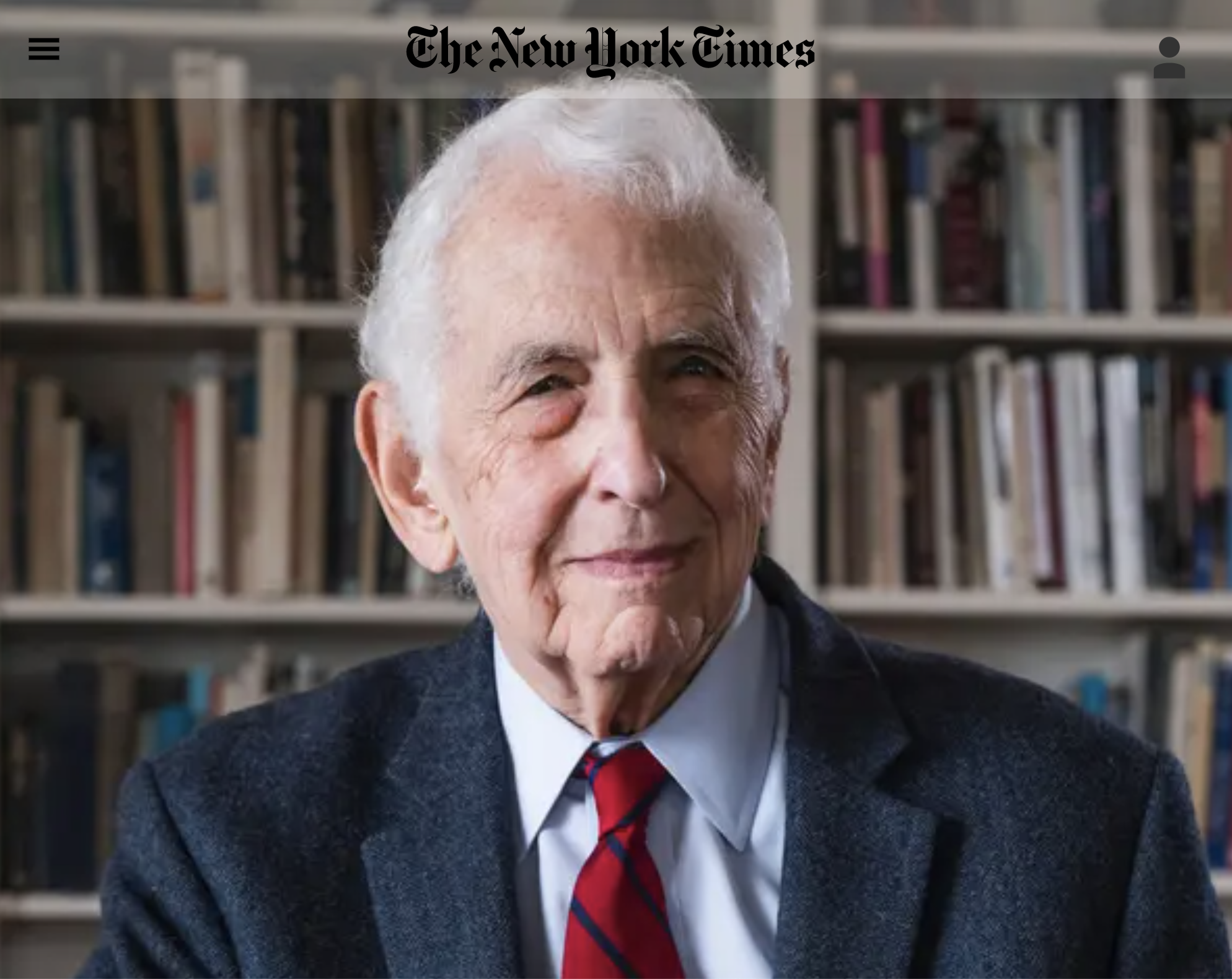
Photo by Andres Gonzalez for The New York Times

The New York Times recently published a Q&A interview and a podcast with Daniel Ellsberg:

The Man Who Leaked the Pentagon Papers Is Scared, by Alex Kingsbury – a Q & A with Daniel Ellsberg, New York Times, 3/24/23

Nuclear Secrets, a Compost Heap and the Lost Documents Daniel Ellsberg Never Leaked, New York Times podcast with Lulu Garcia-Navarro, 4/20/23

Excerpts follow from the just-released podcast.

Continue Reading

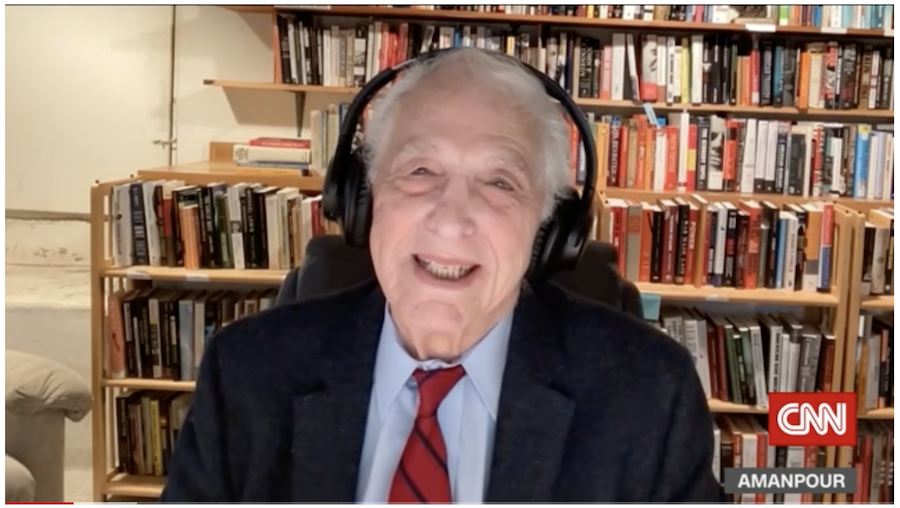
Amanpour’s Interview with Ellsberg on CNN, 3/23/23

Watch Ellsberg’s conversation with Christiane Amanpour, “Speaking Truth to Power: Ellsberg’s Legacy of Courage and Conscience,” aired on CNN on 3/23/23.

Excerpts from the Interview:

Christiane Amanpour:  The 20th anniversary of the Iraq War this week reminds us all of the critical importance of holding governments to account. Fast forward to today, and autocrats are waging wars around the world, from Russia’s latest year-long invasion of Ukraine to Iran’s battle with its own people.

The brave women and men taking to the streets there remind us of the power and value of speaking truth to power. Whistleblowing plays a crucial role in this pursuit. Without it, unjust wars begin and injustices go unchecked.

Daniel Ellsberg is probably the patron saint of them all. Anyone who knows anything about America’s misguided war in Vietnam knows his name to this day, because of one giant leap of courage and conscience. Leaking the Pentagon Papers in 1971, at great personal risk, changed the course of that history by revealing America secretly knew the war was unwinnable.

Fifty years later, Ellsberg is still deeply committed to peace and transparency. But this month, at almost 92, he revealed his latest personal battle after being diagnosed with inoperable pancreatic cancer. So when he joined me from Berkeley, California, we talked about his life, this farewell moment, and above all, how to save lives by speaking out. 

Daniel Ellsberg, welcome to the program.

Continue Reading

Chomsky & Ellsberg – A Joint Interview with Paul Jay

In August 2022, Noam Chomsky and Daniel Ellsberg were interviewed together by Paul Jay for his podcast at theAnalysis.news. An excerpt follows from their conversation.

ELLSBERG: I’m sending stuff to my archives at UMass-Amherst, and I came across in my files this terrific paper by Noam Chomsky, U.S. Involvement in Vietnam, written just after the war had ended, finally in 1975. You probably don’t remember this paper, but I can recommend it to you.

Of course, it reminded me we had been in ’75, you and I, on the same side for eight years, since about ’67, when I came back from Vietnam, working together. With the greatest respect, you’d been on the right side much longer than that, all your life, as far as I know. Before those eight years, I had been participating as part of the wrong side. Anyway, we’ve been in for more than half a century working on this. I have not learned more from any person on Earth. From you, Noam. No one has contributed more.

Continue Reading

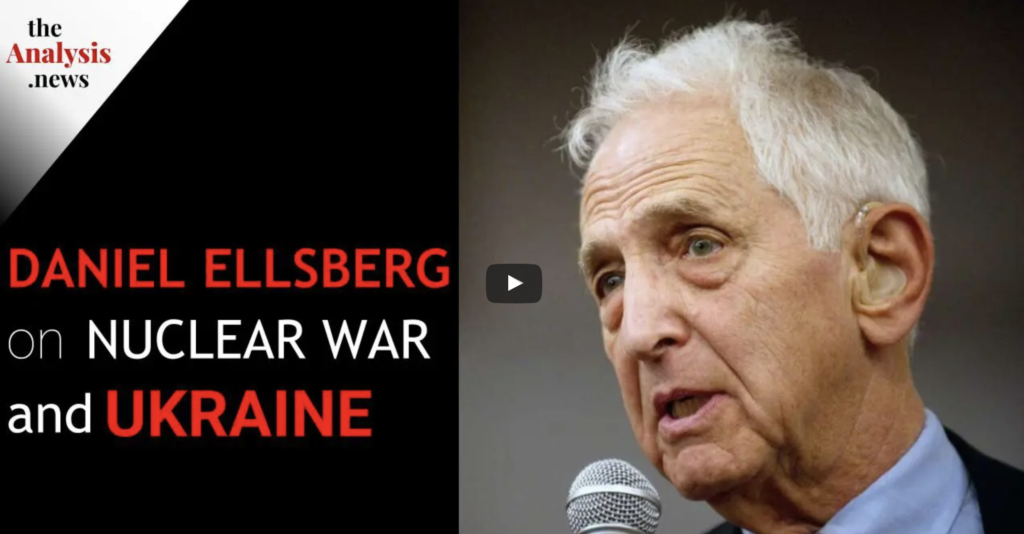
Ellsberg on Nuclear War and Ukraine

Editor’s note: Ellsberg’s 6/18/22 interview with TheAnalysis.News can be viewed here. An excerpt follows from the full transcript.

The Russian invasion of Ukraine has made the world far more dangerous, not only in the short run, but in ways that may be irreversible. It is a tragic and criminal attack. We are seeing humanity at its almost worst, but not quite the worst – so far, since 1945 we haven’t seen nuclear war.

Really, that was unexpected. When I was in my teens, in the 40s, or the 50s, or early 60s, I think almost nobody I knew expected that we would go 70 years after Hiroshima and Nagasaki without another explosion on humans. It could well have happened. We have been very close to it, incredibly close to it.

Yet, something happened that was not easily foreseeable: that each of the superpowers, the US and Russia, allowed themselves to be stalemated or defeated without reverting to nuclear weapons. I think almost nobody foresaw that possibility.

Continue Reading

Doomsday Delusions

On 4/22/22, Daniel Ellsberg joined host Robert Scheer on “Scheer Intelligence” to discuss how close the world is coming to annihilation in the context of the Ukraine conflict. Ellsberg took part in planning a U.S. response to a nuclear attack during the Cold War, an experience that provides him with a unique perspective on this dangerous moment in history. 

Listen to the conversation / read the full transcript >>

Excerpted from the transcript:

Ellsberg: We are approaching an armed conflict between the U.S. and Russia for the first time ever since we put troops in Russia to put down the Bolsheviks in 1918. In all that time, both sides have avoided actually shooting at each other—and for a good reason, which applies right now. We have what we didn’t have 50 years ago: two doomsday machines, as I call them—that is, systems that are designed and readied and rehearsed to destroy most life on Earth.

My colleague Herman Kahn, who invented the term “doomsday machine” as a conceptual idea, was the model for Dr. Strangelove in Stanley Kubrick’s film. Kahn felt that the nuclear threat was necessary, and that to make it credible, you had to prepare to survive it by civil defense, antiballistic missiles and so forth—and you had to be prepared to carry the threat out if necessary.

That was his delusion. It has never been possible to be able to survive as a society, even as a population, from nuclear war. Yet neither side has ever rejected the idea that nuclear war can be prepared for and rehearsed and threatened and risked.

Continue Reading

Ellsberg on the Existential Threat of Global Conflict

Excerpt from article and interview by Sasha Abramsky in The Nation, 4/22/22

Arguably no human on earth has given more thought over the past 65 years to the possibilities of nuclear war—intentional or accidental—than Pentagon Papers whistleblower Daniel Ellsberg. Since Ellsberg joined the RAND Corporation as an analyst in 1958, he has accumulated a vast wealth of knowledge and perspective on how superpowers use their nuclear muscle to impose their will on the world, and on how their political and military elites strategize about conflicts in the nuclear era. …

Last year, I interviewed Ellsberg, who lives in Berkeley, when he turned 90. On Monday, we resumed our conversation. Over the course of one and a half hours we discussed Ellsberg’s understanding of the war in Ukraine, the likelihood of hostilities between China and Taiwan as a spillover effect, the risk of nuclear bombs being unleashed, and the potentially cataclysmic impact the war could have on the ability of the global community to cooperate on anti-climate-change policies.

Read the full article / listen to the interview in The Nation >>

50th Anniversary of the Pentagon Papers Release – 6/13/21

Fifty years ago today, on 6/13/71, the first set of excerpts from the Pentagon Papers was published in the New York Times: Vietnam Archive: Pentagon Study Traces 3 Decades of Growing U. S. Involvement. Leaked by Daniel Ellsberg, the 42-volume top-secret study revealed the history of Vietnam decision-making and the lies that were told by four U.S. presidents to cultivate public support for the war.

Selected Media Coverage

New York Times special report on the 50th anniversary of the Pentagon Papers:

‘We’re Going to Publish’: An Oral History of the Pentagon Papers, New York Times, 6/9/21

The Secrets and Lies of the Vietnam War, Exposed in One Epic Document, by Elizabeth Becker, New York Times, 6/9/21

Continue Reading

Daniel Ellsberg Makes New Unauthorized Disclosure: The Top-Secret 1958 Taiwan Straits Crisis Study

In 1958, a crisis over Quemoy and Matsu in the Taiwan Straits brought the world dangerously close to nuclear war. Morton Halperin’s top-secret 1966 study of the Taiwan Straits Crisis revealed the seriousness with which US military and civilian leaders considered using nuclear weapons against China. RAND’s publicly available version of the study has significant redactions that obscure the nature of the threat. Ellsberg has released an unredacted version of the study.

Main Article:
Risk of Nuclear War Over Taiwan in 1958 Said to Be Greater Than Publicly Known, by Charlie Savage, New York Times, 5/22/21

Follow-On Articles:
Daniel Ellsberg Is 90 Years Old and Still Causing Trouble, by Charles P. Pierce, Esquire, 5/24/21

US Generals Said Nuclear Bomb Would Tame Mao, by Ben Hoyle, The Times (UK), 5/24/21

Continue Reading

50th Anniversary of the Pentagon Papers: Conference, Course & Podcast at UMass Amherst

Although it is still being processed and is not fully accessible to the public, Daniel Ellsberg’s archive at UMass-Amherst is already in active use. The university’s recent acquisition of the Ellsberg papers, together with the pending Pentagon Papers 50th anniversary, informed the recent Truth and Dissent conference, a yearlong graduate course, a new archive web resource, and a 5-part podcast by GroundTruth.

—The University of Massachusetts-Amherst recently hosted Truth, Dissent & the Legacy of Daniel Ellsberg, a two-day online conference marking the 50th anniversary of the release of the Pentagon Papers. Ellsberg’s keynote address plus seven roundtable discussions explored the major issues that have engaged his life: the Vietnam War, nuclear weapons, antiwar resistance, the Pentagon Papers, Watergate, whistleblowing, and the wars of the 21st century. Videos of all of the sessions can be viewed here.

—In a related project, GroundTruth launched The Whistleblower. This five-part podcast series explores Ellsberg’s life story through exclusive interviews as well as archival materials.

Continue Reading